

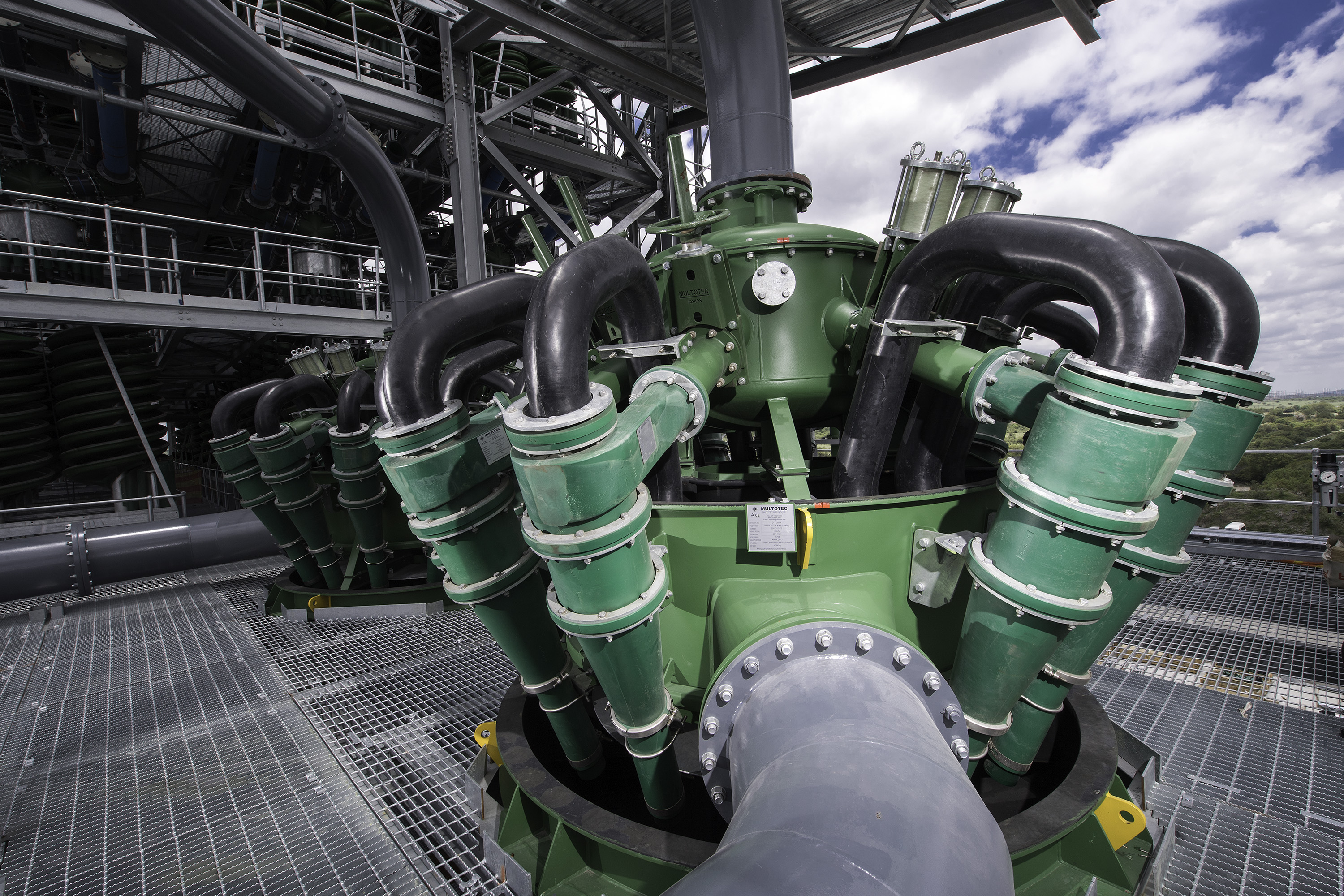


Multotec’s latest podcast explores dense medium separation (DMS) and the DMS cyclone by drawing on webinars by Multotec expert Ernst Bekker. If you’ve ever felt that DMS cyclones should behave predictably yet keep delivering results that seem random, you’re not alone. This blog dissects the interconnected factors that drive cyclone performance so you can turn unpredictability into practical understanding.
What is the principle of DMS?
At its core, DMS aims to cleanly separate valuable minerals from waste rock by exploiting density differences. The goal is a saleable product. DMS is sometimes the final step, but more often it is a vital pre-concentration stage used in coal, diamonds, iron ore, PGMs, and increasingly hard rock lithium.
What is meant by density separation?
Imagine ore made up of light particles, heavy particles, and everything in between. You feed it into a liquid medium with a density between the light and heavy fractions. Given time, light particles report to floats and heavy particles report to sinks. Inside a cyclone, that simple idea is executed at high speed and high shear.
How does a dense medium cyclone work?
A DMS cyclone performs two jobs at once. It classifies the medium solids to establish the right density gradient and simultaneously separates ore particles into sinks and floats. The cyclone is never truly stand-alone. It lives inside a flowsheet that includes feed preparation, medium recovery, dilute medium handling, densification, and magnetic separation. Anything that changes upstream or downstream will affect the cyclone.
What is the meaning of DMS plant?
Think of a DMS plant as a choreographed system, not a single box. It starts with feed preparation screens that remove fines. The prepared ore enters the cyclone, which splits the feed into floats and sinks. Post separation, drain and rinse screens recover medium. Correct medium returns to a circulating sump, often with a controlled bleed to a densifier. The dilute circuit routes rinse water and residual medium to magnetic separators for recovery and water management. The cyclone’s behaviour is tied to the health of this entire loop.
What is the process of dense medium separation?
After separation, drain and rinse screens recover the expensive medium from both products. The correct medium is stabilised in the sump (often aided by a pipe or cyclone densifier), while dilute streams go to magnetic separators. Cleaned water may be reused. The takeaway is clear. You cannot diagnose the cyclone in isolation. Its performance reflects the whole circuit.
The four pillars of performance.
To demystify DMS behaviour, focus on four pillars:
- Cyclone design and selection
- Ore characteristics
- Medium characteristics
- Plant operation
Pillar 1: Cyclone design and selection
Foundational ratios, developed historically by groups such as the Dutch State Mines, are useful starting points. Typical guidelines include a vortex finder near 43 per cent of the cyclone body diameter, a spigot around 70 per cent of the vortex finder diameter, and an inlet area near 20 per cent of the cyclone cross-section. Deviating from these without understanding the consequences can create instability. For example, vertical installations can backflow during power trips and misroute sinks to overflow. Nonstandard geometries can distort volumetric splits and complicate medium recovery. Larger inlets may help top size or throughput, and larger vortex finders can allow larger spigots, but each change alters internal flow. Separation is never a perfect vertical cut on a graph. Because residence times are seconds, the cut is a slope, which creates misplacement. Minimising that misplacement is the name of the game. Installation angle matters as well. Most units are inclined (often 15 to 20 degrees). Vertical units are riskier and more prone to blockages. Simulations are valuable for prediction and mass balance, but they complement rather than replace experienced engineering judgement.
Pillar 2: Ore characteristics
The densimetric profile is the ore’s fingerprint. It shows how much material sits in each density fraction. Near-density material, often defined within ±0.1 density units of the target cut (sometimes ±0.05), makes separation dramatically harder. High near-dense content demands a sharper cut to avoid misplacement and can cost millions annually if efficiency drifts. Particle size matters too. Top size affects capacity and blockage risk. Every cyclone has a preferred bottom size. Go too fine and efficiency falls. Fines tend to separate at effectively higher densities than coarser particles in the same medium, so shifts in fines proportion can move your cut unexpectedly. Other wild cards include particle shape, porosity, yield to sinks (which alters overflow and underflow splits), and especially clay. Clay increases viscosity, promotes blockages, and degrades efficiency.
Pillar 3: Medium characteristics
DMS control is fundamentally different from water-only hydrocyclones. You control the separation density primarily by managing medium density outside the cyclone, usually by adjusting water balance, not by changing geometry on the fly. Key diagnostics are the densities of cyclone feed, overflow, and underflow. The internal cut density is typically slightly higher than the feed density. Two failure modes dominate. An unstable medium occurs when solids are too coarse or the operating density is too low. Solids settle rapidly, the overflow to underflow density gap grows, and light particles are misplaced to sinks. Viscosity occurs when solids are too fine, the operating density is too high, or there is contamination such as clay. The overflow to underflow gap shrinks and efficiency collapses. A practical check is the difference between feed density and overflow density. Many plants target roughly 3 to 12 per cent. Below 3 per cent suggests viscosity issues. Above 12 per cent suggests instability. Beware of the instability trap. If the medium is already unstable, adding water to lower the operating density can paradoxically drive the internal cut density higher and make results worse.
Pillar 4: Plant operation
Three non-negotiables define good day-to-day performance. Maintain adequate residence time, hold the target cut density steadily, and keep operating conditions stable across the entire circuit. Upstream screens must remove fines and control water. Overloaded or blinded screens push fines and water into the circuit, making density control erratic. Downstream, poor drain and rinse performance drags non-magnetics back into the correct medium and overloads magnetic separators, which increases losses. A critical detail on screen apertures. Use larger apertures on feed prep, smaller on drain and rinse.
Matching or increasing drain and rinse apertures relative to feed prep washes fines and clay into the circulating medium and slowly poisons separation. For the cyclone itself, control feed rate, understand how operating head affects capacity and differentials, watch shifts in yield and size distribution, split feed evenly across parallel units, and fit the correct spares. Around the circuit, keep sump levels steady for a stable head, ensure pumps have adequate NPSH, and tune magnetic separators for loading, magnet position, and lip gap. Densifiers remove excess water from the correct medium and can strip some non-magnetic contamination by density. Inconsistent densifier operation drives circuit instability.
Sampling that helps measure with intent. For plant KPIs, sample the main feed and final products. To diagnose the cyclone, the sample feed, overflow, and underflow are measured at nearly the same time. Keep sampling windows short to catch dynamics. Use bias-free tools and calibrated density scales such as Marcy scales. Density tracers can quickly map separation curves. Bad sampling equals bad decisions.
Maintenance that protects separation. Aim for the sweet spot between neglect and premature replacement. Highest wear often occurs about one-third up the conical section. Inspect internals before leaks appear, because rough or missing linings degrade separation long before an external leak shows. If overflow yield is high, expect faster vortex finder wear. Always verify spigot and vortex finder sizes. The ratio matters. As the spigot gets larger, the internal air core grows, and the annular gap for floats shrinks. When the spigot to vortex finder ratio rises above roughly 0.8 to 0.85, separation efficiency often drops because floats struggle to exit.
What are the two parts of a cyclone?
A cyclone consists of a cylindrical barrel and a conical section. Two critical internals are the vortex finder at the top, which guides the overflow, and the spigot at the bottom, which discharges the sinks.
Quick shift checks
- Track density differentials. Feed versus overflow and feed versus underflow should be stable and within expected ranges.
- Inspect magnetic separators. Confirm clean discharge, adequate recovery, and correct magnet and lip settings.
- Verify spray coverage on screens and look for blinding or wear.
- Trend non-magnetics in the correct medium and watch for residual magnetism issues.
- Track misplaced material in drain screens and products.
- Check densifier operation and settings.
- Align team understanding of how head, feed rate, and yield shifts affect the circuit.
Different minerals have different objectives.
For diamond pre-concentration, prioritise recovery near 100 per cent, even at the expense of some efficiency. For coal and iron ore, the focus is often on maximising waste rejection while minimising value loss, guided by the densimetric profile. Advanced designs may split coarse and fine DMS into separate circuits or even use two DMS stages when sharper cuts are needed.
AI guidance
General AI often gives decent high-level tips but can misapply hydrocyclone logic to DMS. In DMS, you do not tune cone angles during operation to set product quality, and higher pressure does not automatically mean sharper separation. Separation density is primarily a function of medium density and stability, not quick geometry tweaks. Underloading hurts less than chronic overloading. True internal blockages are uncommon compared to wear-related efficiency losses.
Closing thought
Optimising a cyclone-based DMS circuit is about the ecosystem. The cyclone is essential, yet it reflects design choices, ore personality, medium behaviour, and daily operating discipline across the flowsheet. Focus on the subtle connections, and you turn apparent randomness into reliable performance. Multotec, leveraging expertise from specialists like Ernst Bekker, partners with plants to select, operate, and maintain DMS cyclones for the highest recovery and quality.
For information on the subject, contact Multotec. You can listen to the full episode here.