

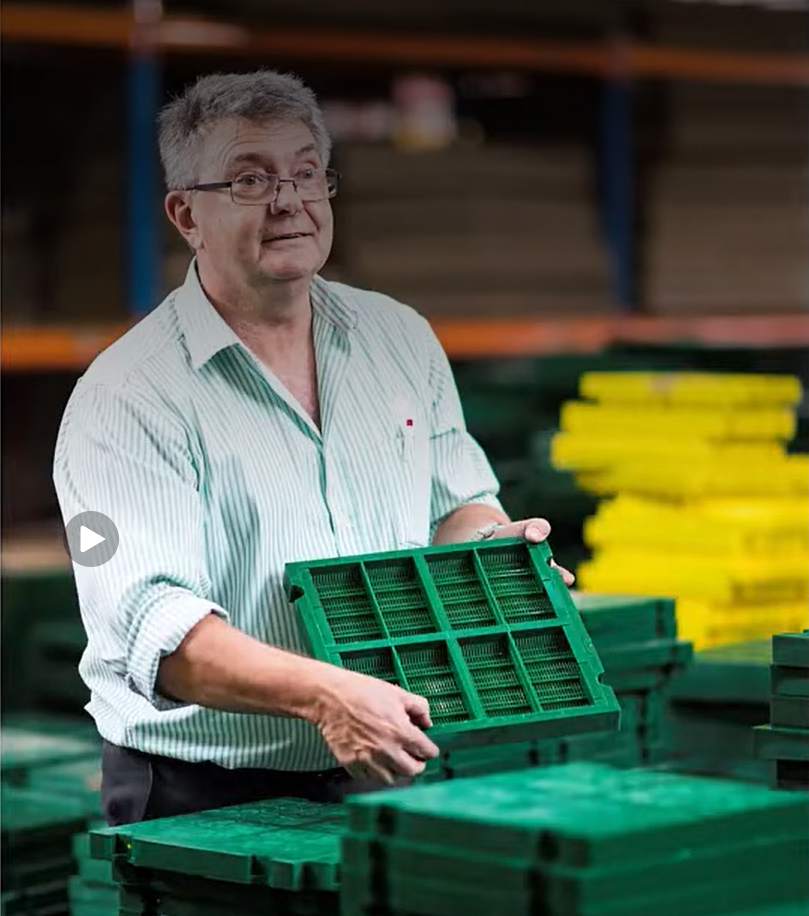


Fine screening tricks of the trade: what every mineral processing operation needs to know
Fine screening is one of those areas in mineral processing where the difference between good and poor practice is measured directly in rands and tonnes. Get it right and you recover more medium, reduce moisture, improve classification and protect downstream processes. Get it wrong and the costs accumulate quickly, often without an obvious single point of failure.
In this Multotec webinar, Fine Screening: Tricks of the Trade, Roy Roche, Vice President of Screening Media Global at Multotec, draws on the company's combined global experience to share practical insights on fine screening applications, panel selection, deck optimisation and process challenges encountered across five continents.
How does Multotec define fines in the mining industry?
Multotec defines fines as all material below two millimetres, though this varies across industries and regions. In Australia, fines are typically defined as minus one millimetre, while in some regions the threshold is minus half a millimetre. In the silicon glass and aggregates industries, the definition differs further. Ultra fines, defined as minus 75 microns, are a separate category altogether.
One of the most important and often underestimated variables in fine screening is moisture content. In mining applications, moisture levels between 8% and 16% present the greatest risk of pegging and blinding on screen panels. At moisture contents of 80% and above, overwash becomes a concern and must be carefully factored into screening capacity calculations.
What are the main types of fine screening applications?
Fine screening covers a broad range of applications, each with distinct requirements:
- Classification separates undersized from oversized material.
- De-sliming removes fine material below half a millimetre ahead of downstream processes, and efficient de-sliming is critical to the performance of dense medium circuits.
- Heavy media recovery involves the recapture of ferrous silicon or magnetite and is a significant cost driver.
- Dewatering reduces moisture in material ahead of conveying and transportation.
- Trommel and trash removal applications address organics and contamination in sand processing
Each application demands a different approach to panel selection, screen design and operating parameters.
Why does panel selection matter so much in fine screening?
Screen panel choice and design directly affect media losses, screening efficiency and operating costs. Drainage capacity is governed by a combination of panel characteristics, screen design and feed material properties. At least eight parameters influence screening efficiency, including particle size distribution, particle density, particle shape, open area, material of construction and the overall panel design in terms of dam widths and perforated thicknesses.
Poor panel selection and inadequate panel maintenance can significantly increase media consumption. Multotec conducted a study in which proper panel design and maintenance reduced magnetite consumption from 130 grams per tonne to 80 grams per tonne. At the time of the study, this represented a saving of R2.5 million per annum. In today's terms, that figure exceeds R5 million in annual savings on a single operation.
Multotec currently holds more than 3,730 panel designs with apertures below two millimetres, covering light, medium and heavy-duty applications across coal, iron ore, heavy minerals and base metals.
What innovations are improving fine screening performance?
One of Multotec's recent developments is the TP pyramid panel, which increases open area by at least 50% compared to conventional designs. On a dewatering screen, feed typically arrives at 25% to 30% moisture. The target discharge moisture is between 12% and 15% to ensure the material is conveyable. The TP panel assists in breaking up the bed depth to allow surface moisture to migrate through to the underside of the screen, improving overall dewatering performance.
Multotec has also developed a visual wear indicator system for screen panels. As a panel wears, a series of indicator dots appear progressively across the surface. By the third or fourth indicator, replacement is required. This removes guesswork from maintenance scheduling, reduces unplanned production losses and improves spares inventory management.
Why are deck maps critical to screening efficiency?
A screening deck is not a uniform surface. It comprises three distinct zones: the impact area at the feed end where material first lands, the distribution and screening zone that follows, and the main screening surface leading to discharge. Each zone experiences different conditions and requires a different panel design. Optimising the full deck rather than treating it as a single surface is one of the most effective ways to improve screening efficiency across an operation.
What types of screens does Multotec offer for mineral processing?
Multotec offers a comprehensive range of screening solutions designed to meet the demands of mineral processing operations across a wide range of commodities and applications:
- Screen panels – modular rubber, polyurethane and metal panels configured into customised screen decks for sorting, classifying, scalping, de-sliming and dewatering. Standard modular sizes are 305 x 305 mm and 305 x 610 mm, with custom sizes available.
- Trommel screens – rotating drum screens custom engineered for screening and washing, available in self-driven configurations from 1 000 mm to 4 000 mm in diameter and up to 15 000 mm in length.
- Sieve bends – curved arc screens in polyurethane or wedge wire used for dewatering, de-sliming, media recovery and trash removal.
- Static screens – custom built sloped screen decks used to pre-screen feed material and reduce the load on downstream vibrating screens.
- Dewatering screens – designed to remove water from mineral streams while retaining fines, with precision apertures available from as small as 0.5 mm.
- Centrifuge baskets – wedge wire baskets for industrial centrifuges, designed to improve solid and liquid separation and reduce product moisture.
- Interstage screens – seamless wedge wire cylinder screens for gold CIP and CIL tanks, available in diameters from 500 mm to 1 900 mm.
How does Multotec's global experience translate into customer value?
Multotec operates across six regions globally, including Africa, Australia, China, Chile, Brazil and Canada, with a combined screening specialist experience of more than 3,500 years across all product lines. This global footprint enables the company to draw on observations and learnings from site visits across multiple commodities and geographies and translate these into practical, cost-effective solutions for customers.
As Roy Roche puts it, the goal is simple: to provide solutions that allow customers to sleep easily at night.
For more information on fine screening solutions for your operation, contact Multotec.