

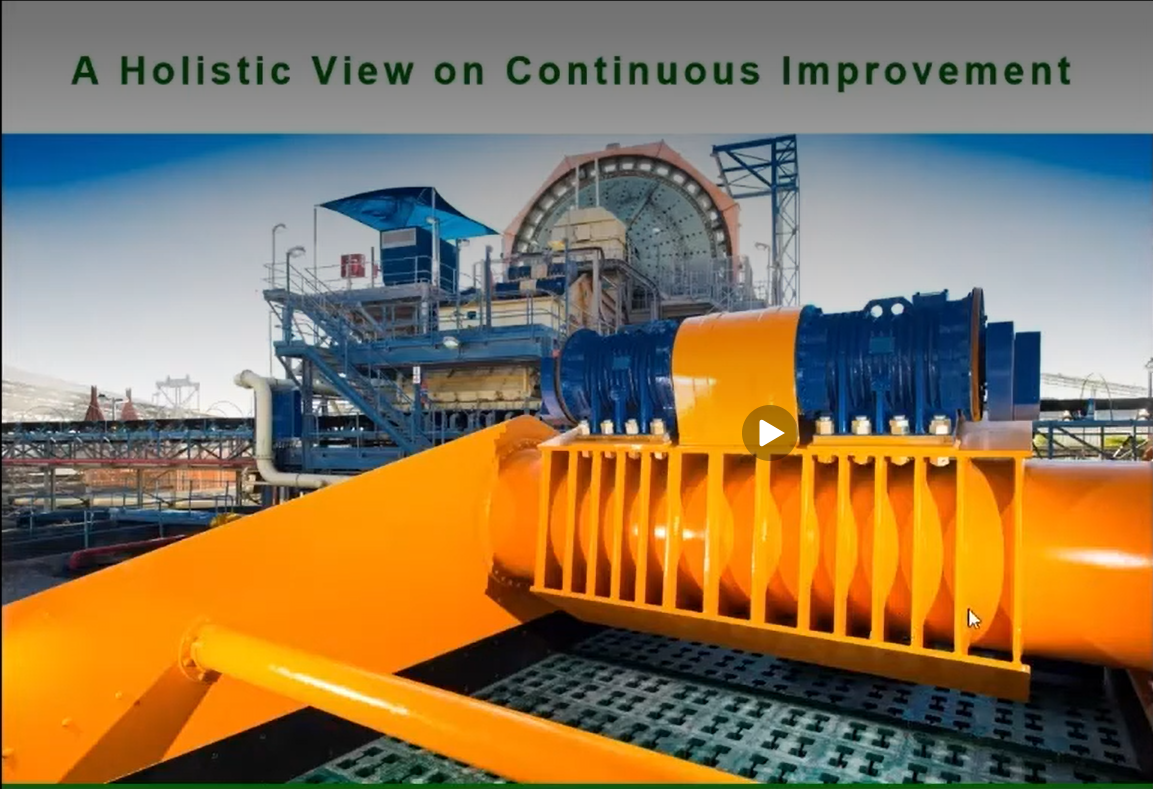


Continuous improvement is one of the most cited phrases in corporate strategy but one of the least understood in practice. Most organisations focus their improvement efforts on technology, process efficiency and people development. Fewer stop to examine the invisible force that either accelerates or quietly undermines all three: organisational culture.
In this Multotec webinar, A Holistic View on Continuous Improvement, the presenter makes the case that culture is not a soft, secondary concern. It is a core operational variable that every mineral processing leader needs to understand and actively manage if they are serious about driving lasting change.
What does a holistic approach to continuous improvement actually mean?
Before unpacking culture, it is worth pausing on the word holistic. The phrase "the whole is more than the sum of its parts" is familiar to most business leaders, but it is not always applied in practice. In a mineral processing plant, it is entirely possible to maximise efficiency in one area while creating inefficiencies elsewhere. If improvement efforts are not coordinated across the entire operation, the gains made in one part of the plant can be cancelled out by losses in another.
A truly holistic approach means keeping the full picture in view at all times. A plant or organisation must be understood as a complex system, one where people, processes, technology and culture all interact. Optimising any one of these in isolation will only go so far.
What are the four pillars of continuous improvement?
When organisations set out to improve performance and reduce costs, they typically focus on four areas: technology, process, people and organisational culture. The first three are well established. Technology is often the instinctive starting point for engineers: find a solution, deploy it, measure the result. Process improvement examines how the organisation itself operates, including approvals, procurement and workflows. People development addresses skills gaps and team performance.
But culture, the fourth pillar, is where many improvement initiatives quietly stall. It is also the one most frequently overlooked. Understanding why requires a closer look at what culture actually is and how it shapes the way an organisation behaves.
What is organisational culture and why does it matter in mineral processing?
Culture is not what is written on the walls or printed in a values statement. It is what people actually do every day. It is the collective patterns of behaviour, the unwritten rules, the stories colleagues tell each other, and the rituals that define how things get done. As the presenter puts it simply: "That's the way we do things around here."
Understanding your culture requires looking at several indicators: the rituals and rites of passage within the organisation, the norms that govern behaviour, the values instilled by the company's founders, which research suggests account for up to 40% of an organisation's culture, and the narratives that circulate among teams. These are the signals that reveal where a culture truly sits, often far more honestly than any formal values document.
A useful analogy: culture is like the water a fish swims in. The fish never questions the water but the water shapes everything. Becoming more conscious of your culture is the first and most important step towards understanding whether it supports or hinders your improvement goals.
How do you build a shared language around organisational culture?
To work with culture effectively, organisations need a shared language to describe it. A few key concepts are worth understanding. Cultural relativism is the ability to assess a culture on its own terms, without judging it against another. In a South African context, or in any multinational business, this is particularly important. The dominant culture within an organisation should not assume superiority over others. Respecting cultural differences is not just good practice, it is essential for building a cohesive and high performing team.
Enculturation refers to the process of learning and absorbing the values of an organisation. Every new employee goes through this process, whether consciously or not. Acculturation describes what happens when different cultures meet and begin to influence one another, something that happens naturally in diverse organisations and can be a genuine source of strength when managed well.
Why does organisational culture so often block continuous improvement?
The most striking insight from the webinar is this: culture eats strategy for breakfast. If your improvement strategy runs counter to your existing culture, it will not be sustained, no matter how well designed it is. Continuous improvement requires change, and change is precisely what many organisational cultures resist. They default to the status quo and in doing so, they quietly neutralise the very initiatives designed to move the business forward.
It is a striking contradiction. An organisation can state in its values that it aspires to continuous improvement and then find itself unable to make it happen, not because the strategy is wrong, but because the culture is working against it.
This dynamic plays out at every scale, from a small mineral processing plant to a multinational operation running thousands of employees across multiple continents. The principles are equally relevant to both.
How can organisations align culture with their continuous improvement strategy?
Before an organisation can build its ideal culture, it must first understand its real one. That means developing cultural knowledge, an honest assessment of current behaviours, norms and values, and creating the language to talk about culture openly. Only then can leaders begin to close the gap between where the culture is and where it needs to be to support a genuine continuous improvement mindset.
When culture and strategy are aligned, the results are sustainable. When they are not, even the best improvement programmes will fall short. Culture is not a peripheral concern. It is intrinsic to the success of any organisation, and no holistic improvement journey can begin without it.
For more information on continuous improvement in mineral processing, contact Multotec.