

- Home
- Articles & News
- Design investigation through CFD analysis of a cyclone
Design investigation through CFD analysis of a cyclone
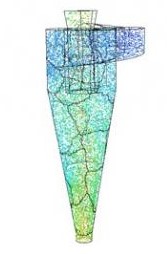
Particle residence time
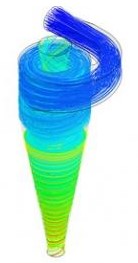
Particle streamlines
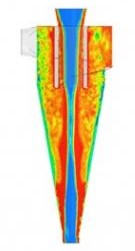
Water volume fraction
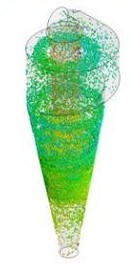
Particle velocity magnitude
Multotec is currently in the process of performing an in depth CFD analysis on our classification cyclones. The objective of the study is to create representative CFD models of classification cyclones with several different geometric variances. Evaluation of the flow and separation characteristics of these CFD models will allow Multotec to remain at the forefront of cyclone design by understanding the effects of geometric alterations on efficiency and wear.
CFD (Computational Fluid Dynamics) uses numerical methods to solve the fundamental nonlinear differential equations that describe fluid flow for predefined geometries and boundary conditions. The result is a wealth of predictions for flow velocity, temperature, density, and chemical concentrations for any region where flow occurs.
DPM and EM
In the mining and process industry, the simulation of particulate flow is one of the most significant research topics. The two most common methods of slurry analysis are the Discrete Phase Model (DPM) and the Eulerian Model (EM). The DPM calculates the conditions of each particle within the simulation region but does not account for the volume of these particles. The EM simplifies each particle size band into a continuous phase and accounts for their volume fractions. Each of these models has their advantages and disadvantages, especially in regions with low and high particle loadings.
The model being used by Multotec is a hybrid model known as the Dense Discrete Phase Model (DDPM). This model offers a profound advantage over DPM by accounting for the volume fraction and particle interaction of the particulate phase in an Eulerian framework. This is very important due to the high volume fraction of solids typically found in a cyclone. A total amount of particles are currently being tracked as they move through the cyclone. This makes the model extremely computationally expensive but provides a more representative simulation compared to DPM or the EM.
These CFD simulations are instrumental in investigating possible improvements with regards to separation efficiency, particle trajectories, wear and pressure drop. The CFD simulations are also crucial in determining the factors responsible for possible inefficiencies (such as short circuiting of particles) and provide Multotec with a deeper understanding of the operating principles that govern cyclone design.