

Getting the better of water management challenges in wet processing

Exclusive feature, as published in Capital Equipment News.
While wet processing is a crucial part of mineral processing, water scarcity remains one of the burning environmental issues that operations have to contend with. However, wet processing solutions from various OEMs are helping mining and quarrying companies overcome water management challenges.
Within the extractive industries, the value of materials is significantly increased when washed, but water is a sensitive subject. According to Gerrit du Plessis, product specialist at Multotec, a major problem for mines and quarries currently is that it is becoming increasingly difficult to obtain the requisite water use licences for expansions.
 “Another challenge is that deteriorating water quality due to reuse without treatment can have knock-on effects such as lower recovery rates where chemicals are involved and scaling due to an increase in the hardness of the water. There is also, of course, an increase in costs when contaminated water has to be stored,” explains Du Plessis.
Wayne Douglas, head of R&D, Innovation and Minerals Testing & Research Centre (MTRC), Mining Industry, FLSmidth, reasons that with growing populations, a larger middle class and the transition to a low carbon, green energy future, the demand for minerals will only increase in the next decade. This means a greater environmental impact from mining. A more sustainable future, he says, requires action and FLSmidth is leading the move towards zero emissions in mining, without compromising quality or its customers’ commercial competitiveness.
“An average size concentrator with a capacity of 100 000 tonnes/day can require 50 000 to 70 000 m³ of makeup water per day. Often our largest mineral resources are found and mined in highly water-stressed regions. To address this challenge, FLSmidth provides a full suite of technologies for water recovery, including thickened tailings, paste tailings as well as filtered tailings solutions that can recover up to 95% of the water used in the process. With our full tailings solutions, EcoTails, we can provide fast filtered tailings that can be blended with waste rock to form a geotechnically stable GeoWaste that can then be conveyed and stacked,” explains Douglas. Every mine is different and has its own requirements and challenges, adds Douglas.
Therefore, FLSmidth houses a full suite of testing, engineering services and technology dedicated to finding the right solution for its clients. Kwatani is one of the leading custom-designed vibrating screen original equipment manufacturers (OEM) in South Africa. Its view with regards to water management related to wet screening applications is about retaining water in the water reticulation system. “This is achieved by reducing water overflow over the screen’s discharge end. Other factors are the quality of water, scaling of pipes that restrict waterflow and suspended solids in the water that leads to increased wear and leaking of water pipes, among others,” says Kenny Mayhew-Ridgers, COO of Kwatani.
Leveraging research
Innovations in the washing sector are helping mines and quarries overcome challenges around water management. For example, Kwatani’s research and development team made use of the latest research publications available on dewatering. “Interpretation of the publications showed clearly that the way the dewatering banana screen has been designed since its existence is not ideal. This led the Kwatani development team to engineer a new innovative banana screen design that still looks like a banana screen but outperforms traditional designs,” says Mayhew-Ridgers.
Kwatani’s approach takes into consideration the type of screening panels used together with the process parameters and the screens’ mechanical parameters, of which there are at least seven; this ensures optimal performance. “This approach is different from others; the screen design remains the same while screening panels are replaced with other types of panels until a solution, and in many instances, a compromised solution, is found. Kwatani relies on its four decades of experience, in-house research and development team and test laboratory to come up with the best design for the application at hand,” adds Mayhew-Ridgers.
A key case study is where Kwatani was approached by a South African diamond mine to improve the performance of its degrit process as the amount of water carryover that the operation was experiencing limited its existing screens’ throughput. Kwatani applied its new innovative approach to banana screen designs that required the adjustment of several of the mechanical parameters. “This was accomplished while being able to fit the newly-designed screen on the existing footprint without any changes required to the plant. Significantly, the Kwatani banana screen managed to double the mine’s throughput without increasing the size of the screen. This success speaks for itself,” says Mayhew-Ridgers.
Optimum water recovery
FLSmidth’s array of tailings management solutions is one way the OEM can ensure optimum water recovery and tailings disposal. Coupling that with its full flowsheet strength, FLSmidth is able to look upstream for opportunities on processing conditions that affect tailings requirements such as milling and flotation. The ability to optimise particle size distribution and metallurgical recovery with tailings in mind can further improve downstream impact to tailings.
“Optimised grinding with pump and cyclone performance is one example of ensuring we efficiently optimise both the energy efficiency and particle size cut to ameliorate metallurgical recovery while minimising fines generation,” says Douglas. “Flotation technologies such as MixedRow combine the unique performance of our nextSTEP forced-air with naturally aspirated WEMCO to ensure valuable minerals are not lost as tailings. Our array of advanced sensors such as LoadIQ, FrothVision and BulkExpert for Tailings provide the advanced sensing and process control needed to both minimise plant upsets and maximise performance,” adds Douglas.
FLSmidth was recently chosen as the preferred provider for four large, bolted thickeners for a coal plant in Mozambique. Two of the thickeners are designed to reduce water load on the filters, allowing for a drier filter product, while the other two thickeners recover water from the plant tailings. The installation, which includes E-Volute feedwell technology, will contribute to achieving optimal water balance in the plant. Elsewhere in the African region, FLSmidth vacuum disc filters are playing a vital role at a new copper mine in the DRC in preparing tailings slurry for a backfill application. Four 3,8 m disc filters provide a cost-effective dewatering strategy, resulting in a cake dry enough to be mixed with cement and other additives before being transported underground to be placed in mined-out workings as backfill.
Further afield, FLSmidth has completed an innovative project for Hindustan Zinc Ltd (HZL) at its Zawar location in India. The tailings dam at Zawar was reaching capacity for conventional wet deposition with no space nearby to expand. The company was looking for a tailings management system that offered significant benefits in terms of environmental sustainability, process water recovery and a reduced footprint for the tailings storage facility. “After evaluating several alternatives, HZL chose our dewatering concept, comprising a high-density thickener and E-disc filter technology. A key benefit of the system is the recirculation of more than 86% of the process water present in the tailings,” explains Douglas.
Conserving water
Dewatering of waste and concentrate streams as part of wet mineral processing is crucial to conserving water and to reducing mineral processing operational costs, says Multotec’s De Villiers.
“Our filter press technology plays an important role here to recover maximum water and produce a dewatered product suitable for economical conveying to the next process step or to discard the waste economically,” he says. “Our filter presses can improve cake dryness, produce clean filtrate and reduce processing times by up to 10 minutes per cycle. Automated feed introduction, material discharge, pressing and filter cloth self-cleaning are featured across this range.”
Commenting on the benefits, De Villiers says waste streams generated in wet mineral and chemical processing streams result in increasing levels of contaminants and it becomes more difficult to separate the impurities from the water. Multotec supplies robust centrifuge technology to recover waste or product crystals after evaporation/crystallisation steps to provide a concentrated product or waste stream that is economically manageable by the end-user.
The water is recovered from the evaporation/crystallisation steps within specification and water can be re-used in the process again. Saleable products can also be produced by crystallisation, followed by dewatering, and product washing in the company’s pusher-type
and Conturbex-type centrifuges. For high-purity product requirements the pusher-type centrifuge provides high washing efficiencies.
Multotec centrifuges are used in many dewatering and classifying applications in the global minerals processing industry and are able to achieve accurate solid/liquid separation. Sourced from Siebtechnik Tema, they are of compact design, making them ideal for small operating areas. Commenting on some key case studies where this technology has been deployed, De Villiers says one example is a chrome mine in Limpopo which was faced with various risks in disposing its tailings, and called Multotec for a solution. The mine management was keen to conserve scarce water resources by avoiding evaporation and was also concerned about potential groundwater contamination. “After intensive investigation, which included testing at our Spartan facility in Johannesburg, we recommended our filter press technology. This proved to be highly successful and the filter press was able to immediately recover about 80% of the clean water in the slurry,” says De Villiers. 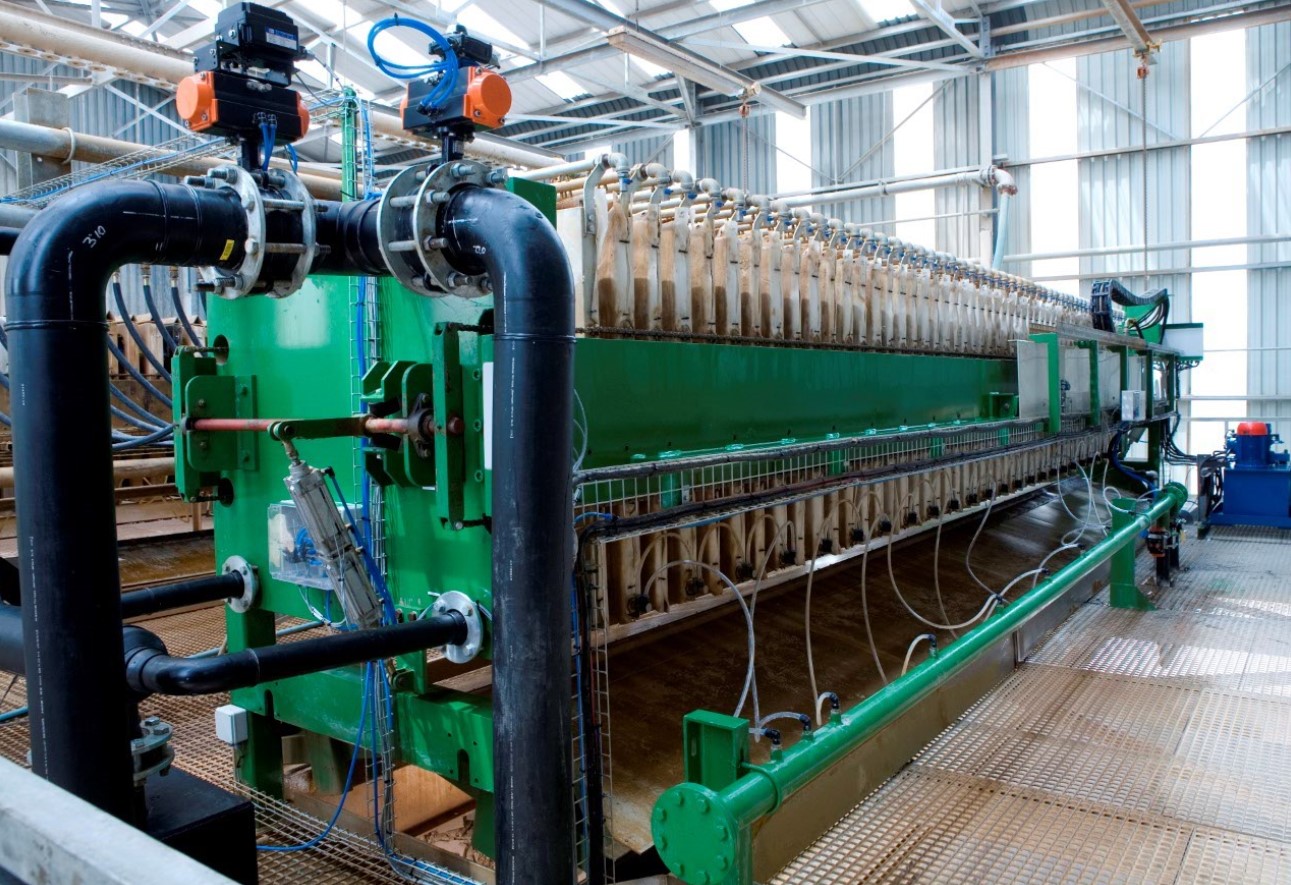
Apart from chrome tailings, Multotec’s filter presses have been used effectively in copper sulphide, copper oxide, coal, gold sludge, scrubber effluent and water treatment sludge applications. The company’s range of equipment and depth of technical expertise allows turnkey solutions, which include the various items of auxiliary equipment around the filter press.
The future
Commenting on some of the trends in wet processing, FLSmidth’s Douglas says the sustainability conversation in the mining industry has matured. It has moved from a general acknowledgment that mining must become more sustainable to a point where the industry recognises that it is now a prerequisite for doing business. “Sustainable practices are increasingly non-negotiable in order to secure investment, meet society’s evolving expectations, gain a social licence to operate and to ultimately ensure shareholder value,” he says.
FLSmidth is focused on all areas of the flowsheet to address the three key areas of MissionZero – water waste, energy waste and emissions. The company is developing Reflux flotation technologies, both for fast flotation and coarse flotation, to minimise water requirements and footprint.
For coarse flotation, FLSmidth’s CoarseAir, will provide efficient metallurgical recovery at a larger size than conventional flotation can achieve. A deposit that can benefit from this technology would require less comminution energy, as well as lower the OPEX and CAPEX of tailings solutions, by allowing a coarser grind size. FLSmidth continues to offer dry comminution technology such as the HPGR that can eliminate water addition upfront. Kwatani’s Mayhew-Ridgers says although screening plays a minor role in the management of water in a plant, Kwatani’s view is that the ideal solution lies in reducing the amount of reject material processed by water. “This can be achieved by eliminating the reject material in the upstream processes. For this reason, Kwatani is closely associated with world leaders in ore sorting technology because we believe this will definitely form part of the future mining improvement solutions,” he says.
In conclusion, Multotec’s De Villiers says there is already more pressure from authorities for mines to use less water and ensure used water is treated instead of stored in tailings dams, and he sees this trend strengthening. “We also believe that the majority of water treatment projects in the future will be driven by SHE departments and not by operations as was typically the case in the past,” concludes De Villiers.