- Home
- Articles & News
- Multotec expands its fine screening toolbox with new High Frequency Panel technology
Multotec expands its fine screening toolbox with new High Frequency Panel technology
As mining operations process increasingly fine and clay-rich ores, maintaining reliable screening performance is becoming more challenging. Conventional fine screening media can be prone to blinding, pegging, wear and vibration-related fatigue, affecting throughput, classification accuracy and plant availability.
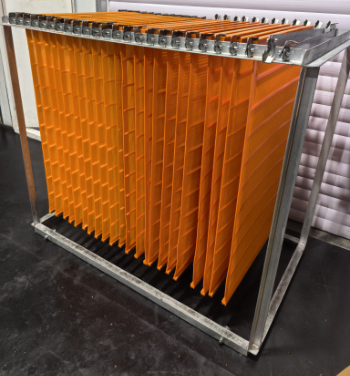 To address these challenges, Multotec will introduce its new High Frequency Panel (HFP) at Electra Mining Africa 2026. Purpose-engineered for high-frequency fine wet screening, the HFP has been developed to balance anti-blinding performance, wear life and vibration fatigue resistance in demanding applications.
According to Jimmy Wu, HFP Manager, Screening Systems at Multotec, the technology responds to a growing need for screening media that can handle the demands of increasingly fine and challenging ore bodies.
 “High-frequency screening places significant demands on screening media, particularly in applications where clay, slimes and fine particles can cause rapid blinding and wear. The HFP was developed specifically for these conditions, helping mines maintain screening performance while reducing the maintenance pressure associated with conventional media,” he explains.
Designed for high-frequency fine screening
The HFP features high open area of up to 45%, supporting increased effective throughput. Its tapered apertures are designed to reduce pegging of particles while an integrally moulded polyurethane construction incorporating Kevlar reinforcing fibres enhances tensile strength and resistance to the cyclic loading associated with high-frequency screening.
Multotec also uses application-specific polyurethane formulations to optimise panel performance and service life according to different operating conditions.
The HFP is suited to applications including ultra-fine classification, desliming, high-solids slurry dewatering and tailings resource recovery across commodities such as copper, iron ore, chrome, platinum group metals and diamonds. In these applications, improved aperture stability can help maintain cut-point accuracy, reduce valuable mineral losses and support more consistent processing performance.
Improving throughput and service life
Compared with conventional fine screen media, the HFP is designed to deliver up to 35% higher screening throughput through its excellent open area. Its fatigue-resistant polyurethane construction is expected to provide a wear life of approximately 1.2 to 2 times that of flat polyurethane panels and 4 to 5 times that of wedge wire or steel mesh, depending on operating conditions.
Its anti-blinding geometry is particularly suited to slime-rich applications where blocked apertures can rapidly reduce screening efficiency.
“The objective is not simply to extend panel life, but to maintain effective screening performance for longer,” says Wu. “For high-frequency screens operating continuously, reducing blinding and unplanned panel changes can make a meaningful difference to plant availability and maintenance requirements.”
Testing to optimise performance
Multotec’s approach includes feed ore characterisation, high-frequency screen testing and on-site pilot trials to ensure the HFP is correctly specified for each application. Testing can assess factors including particle size distribution, solids concentration, clay and slime content, abrasion and slurry rheology, while full-scale trials can replicate the customer’s screen frequency, G-force, deck angle and feed rate.
This enables Multotec to determine the appropriate aperture, polyurethane formulation and deck configuration before implementation, reducing the risk associated with a complete deck conversion.
As mining companies focus on improving recovery, plant availability and the efficiency of existing assets, advanced screening technologies such as the HFP can provide a low-CAPEX route to optimising existing high-frequency screening circuits.
“Fine screening has a direct impact on the wider processing circuit. By maintaining a stable cut point and extending media life, the HFP can help mines achieve more consistent performance in demanding fine-screening applications, concludes Wu.”
With ore bodies becoming increasingly fine and complex, solutions that can improve screening performance while making better use of existing processing infrastructure will be critical to maintaining efficient and reliable operations.