

Multotec is the global leader in trommel screen design & manufacture
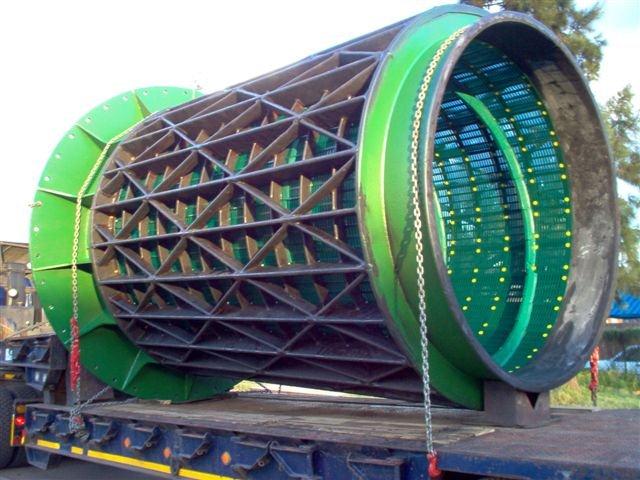 Multotec is the global leader in trommel screen design and manufacture and has been supplying the market for more than 20 years, screening product manager Anthony Yell asserts. “We deal with most of the major mill manufacturers globally. It is a highly specialised segment that was developed in South Africa and Multotec has built a reputation that now enables us to supply internationally.”
Multotec has manufacturing plants in South Africa and Chile and can also supply spare parts from Australia, Chile and the US, which reduces the supply chain dramatically and extends its geographic footprint. “We have supplied mill and scrubber trommel screens to the four corners of the earth, from South America to Papua New Guinea and Siberia to Kazakhstan. There are not many places where they are not prevalent as the Multotec product has proved to be highly reliable.”
Yell explains that mill and scrubber trommel screens fit onto the end of a grinding mill or a scrubber by means of a bolt on flange. Sizes range from 950 mm by 1 200 mm up to a massive 6 m by 6 m. Mill trommel screens are supplied typically into the platinum, gold and copper sectors while scrubber trommel screens are being supplied mainly into the diamond sector.
Self driven trommel screens have their own drive arrangement and are supplied mainly into the heavy mineral sands sector to remove organic material from beach sand, for example, as well as to water treatment plants and coal briquetting plants. Self driven trommel screens are supported on both ends, sitting on a machine tyre and with rollers at the bottom. They are driven through the discharge end by either electric or hydraulic drive. “The latter has proved to be very reliable and allows for the flexibility of full variable speed,” Yell says.
Trommel screens are designed using software such as Finite Element Analysis (FEA) in order to calculate the stresses in the structure for a full rotation. These stresses must be under the maximum permissible level in order to optimise the fatigue life. Mill and scrubber trommel screens have a design life in excess of five years while self driven trommel screens have a design life of ten years. Yell explains that BS 7608:1993 for Fatigue Design Assessment of Steel Structures is adhered to in the design process. Self driven trommel screens are also designed by means of FEA and can also be supplied with a feed and discharge arrangement in accordance with specific customer requirements,” Yell says.
FEA is also used to calculate the requirement for special cross bracing to counter torsional twisting. “When the mill or scrubber starts up, the trommel wants to turn in the opposite direction for a split second. If the trommel is not braced sufficiently, torsional twisting will occur, which will weaken the trommel structure and ultimately lead to premature failure. In addition, the load in a trommel is shifting continuously, placing ongoing stress on the trommel, which complicates the structure,” Yell says. It is such complexity that means that every single trommel screen is unique.
“Multotec custom designs each product to suit the specific application. We size it; we check the load; we examine the material lump size. When a client requests a trommel screen, our first step is to determine the main parameters. There may be a lot of variation in the diameter of the bolt on flange diameter, for example, as it depends on the size of the mill. Thus there is not a standard range apart from the basic design parameters that we use.”
Such is Multotec’s experience in this regard that it prides itself on its ability to turn customer quotes around in 24 hours. “We use sophisticated programmes to design the equipment needed, taking into account the basic FEA requirements at tender stage, whereupon an accurate drawing, price and quote can be generated. The speed and efficiency with which we can respond to a customer’s enquiry put us streets ahead of the rest of the market.”
Yell says the key to the success of Multotec’s trommel screens lies in maintaining the integrity of the rubber lining through regular maintenance. “Trommel screens are generally rubber lined. It is critical to ensure the integrity of that rubber lining. If it wears out it needs to be repaired, as a trommel screen can fail prematurely if its structure is eroded.” The rubber lining protects the trommel screen from corrosion and wear and is fundamental to an extended trommel life.
“If they are maintained properly, trommel screens will last for many years. We have had trommel screens running for over ten years that are still operational,” Yell says. Customers can return trommel screens in order for the rubber lining to be stripped off and the structure subjected to non-destructive testing to determine the integrity of the trommel structure. “If it is still within specification it can be shot blasted and relined, whereupon it will be good to go for many more years,” Yell says.
 Multotec has the added advantage of being able to supply polyurethane panels for smaller feed sizes where the main wear criteria is sliding abrasion and rubber panels where impact is the wear criteria. “We design and manufacture both rubber and polyurethane panels in house,” Yell says. He adds that a recent trend in mineral processing has been that mills are tending to get bigger and therefore trommel screens are becoming larger as well. “This can pose challenges in terms of acceptable life of screen media. However, we do have solutions for this,” Yell says.
“Mill manufacturers often increase throughputs by accelerating the discharge rate out of mills by using so called pulp lifters, which function a bit like a pump impeller to propel the material out of the mill at a higher velocity. The trommel design implication is that we need to stop the feed landing half way down the trommel screen as this reduces trommel efficiency and causes high wear to the screen media. “In order to combat this we have designed what we call a baffle plate placed at the feed end of the trommel that forces the feed down onto the trommel surface to improve screening efficiency,” Yell says.
“If the trommel screen rotates in one direction only, we recommend installing an advancing spiral or scroll in order to be able to control the retention time of the material in the trommel. “The scroll pitch can be designed to increase or reduce the retention time accordingly. Furthermore single or twin start scrolls can be used to further vary the retention time and improve screening efficiency when required. There is a great deal that can be done to optimise output,” Yell comments.
“One of the biggest problems we have today with the larger trommel screens is the high wear rates of the screen media due to the high peripheral speed of the trommel screen itself.” In addition, the trend towards larger mills means higher flow rates and velocities. “Double the velocity on a polyurethane screen equates to an increase in the wear rate by a factor of five,” Yell notes.
“We have invested extensive research and development into producing panels that last longer, as with large copper processing plants where the large tonnages mean an average run time of 12 to 14 weeks without any stoppages for panel change outs. It has been our objective to develop panels that can last that length of time,” Yell says.
This usually requires that trommel screen panels become bigger and heavier. “On the smaller trommel screens we use modular injection moulded panels of 305 mm by 305 mm up to around 2.5 m in diameter. For sizes above that it is more cost effective to manufacture larger panels in either rubber or polyurethane. The challenge is manufacturing panels that are not too large or too heavy for two people to lift and install. Otherwise specialised lifting equipment is required which then complicates the re-lining procedure. ”
From a safety perspective, Yell notes that all the panels are fastened from inside the trommel screen. Everything is installed and replaced from inside the trommel generally by use of polyurethane pins and sleeves. Our solutions mean that that the panels are easy to remove and replace safely,” Yell says.
Another issue related to panel wear is ‘pebble porting’ in semi autogenous (SAG) milling, which sometimes results in hard rounded pebbles that cannot be economically ground down any further being ejected from the mill and sent to secondary crushing. These rounded pebbles, with diameters from 50 mm to 80 mm, can account for up to 20% of the trommel feed needed to be screened out by the trommel screen. “They tend to be abrasive and cause excessive panel wear. Multotec has developed a range of panels that can handle these pebbles and still achieve acceptable life,” Yell says.
“The most important factor for us is understanding the trommel duty and the load coming off the end, because we have to design the front end of the trommel to be able to take this load.” Yell points out. “We have focused investment in developing designs for many years and our trommel screen designs have proven themselves to be exceptionally reliable,” Yell says. “As long as they are maintained properly in terms of the rubber lining and panel replacement then they will last a long time.”