

- Home
- Articles & News
- Multotec warning systems help manage wear and risk
Multotec warning systems help manage wear and risk
 Early warning systems across a range of Multotec’s wear solutions – built in as standard and at no added expense – are important aspects of the group’s efforts to save customers from the high cost of unexpected failure.
According to Spike Taylor, managing director of Multotec Rubber, the systems are simple but highly effective, assisting customers in achieving the longest possible life between replacements and reducing plant downtime.
“Apart from providing customers with cost-effective solutions, we also want our customers to have the best user experience when working with our products,” says Taylor. “To do that, we have designed early warning systems that can be visually checked with ease, and with high levels of safety.”
He highlights that the successful implementation of these systems was done without raising the products’ cost to customer; this was a significant advantage for customers, as most of them use large quantities of Multotec wear products in their equipment.
The Group’s wear solutions are applied to a range of applications including mills and scrubbers, pipelines, transfer points and chutes
Screen panel
Screen panels, produced by Multotec Manufacturing in a range of materials, need to be replaced at the right time if the customer is to derive the most value from them.
“This time can either be just before the metallurgical end-of-life or before the apertures on the panel are worn too large,” Taylor says. “With typically hundreds of panels on a screen deck, and with uneven wear across the screen, it is crucial to identify the most worn panels and to replace them. If this is not done, the panel could wear through and allow large particles to pass through to the underflow and block or damage downstream equipment, not to mention the unplanned downtime that this would incur.”
The wear indicator on each panel comprises four or five moulded cavities in the body of the panel, spaced at predetermined intervals below the upper wear surface.
“The cavities are like pin-holes, large enough to be visible to the naked eye but small enough to prevent material getting into them and blocking them from view,” says Taylor. “As the panel surface is worn away, one cavity becomes visible; as further wear takes place, the second cavity is also visible, and so on until all cavities are visible and the operator knows that replacement must be conducted or planned shortly.”
This simple but innovative system, patented by Multotec, not only indicates when replacement needs to take place, but can be used as a data source to measure the rate of wear so that a future replacement time can be predicted and planned.
“Accurate recording of the time lapse, or the tonnage treated, between the exposure of one cavity and the next allows the customer to calculate a wear rate,” he says. “This rate in turn lets the customer work out the panels’ life with considerable certainty, so that a change-out date can be set.”
The number of cavities that are exposed before replacement is carried out will depend on the different perforated thicknesses or aperture sizes, and the harshness of the application in question.
Cyclones
A wide variety of cyclones is supplied by group company Multotec Process Equipment, among them the HC cyclone range which comprises a mild steel outer shell and an inner wear surface of thick, loose rubber lining.
The key design feature for early warning of wear is a ‘weep hole’ in the mild steel shell,” Taylor explains. “If the rubber lining wears through, or is severely damaged by a large or sharp particle, the slurry will leak between the lining and the shell, and escape from the cyclone through the weep hole – which is filled only with a loose plastic insert. The internal surface of the plastic inserts prevents the liner from blocking the weep hole.”
Being alerted to the lining failure by slurry on the plant floor removes the risk of the steel case being irretrievably damaged while not protected by the lining; this would lead to the expensive and time-consuming process of changing the cyclone body
The advantage of the weep hole is also that the inspection of the cyclone can be done while it is in operation; as soon as a problem is identified, the cyclone can simply be removed from the circuit and if possible substituted while the loose liner is replaced. This also means that the maximum lifespan of the liner can be extracted, helping reduce operating costs.
The natural rubber linings, which come in thicknesses of 15 mm and 25 mm, have three times the life of conventional liners. A new compression moulded rubber is also available, having been developed by Multotec after extensive research and testing.
Rubber wear plates
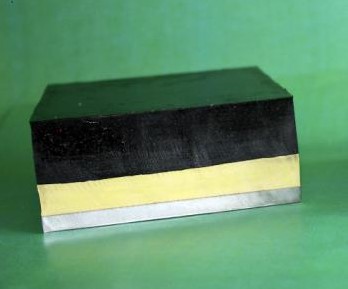
To combat wear in ore transfer chutes and similar applications, Multotec Rubber supplies rubber wear plates which now also come in ‘Yellow Belly’ format.
“Our recent innovation with these products has been to colour the layer of rubber immediately above the steel backing plate a bright yellow, hence the name,” says Taylor. “When the wear on the rubber plate reaches the level of the yellow rubber, the colour is easily visible during inspections; this indicates that there is still some life left in the plate but that replacement must be conducted in the near future to avoid damage to the backing plate.”
He emphasises that the yellow rubber is the same good quality as the black rubber that Multotec has installed in high impact and high abrasion applications throughout Africa. So the remaining wear, after the yellow colour is first exposed, gives the plant operators time to decide whether they want to replace the plate immediately or address it during an imminent, scheduled process plant shutdown.
Multotec’s rubber wear plates range in size up to 1 260 x 1 320 mm and 1 000 x 2 000 mm, which can be cut to suit the liner configuration. They are available in a thickness from 40 mm to 200 mm including the steel backing plate which measures from 3 mm to 10 mm thick, depending on the rubber thickness and the application.
Ceramic tiles
Multotec engineers its ceramic wear solutions to order, according to individual customer requirements; a full on-site wear audit is the best way to determine which lining solution will best suit the customers’ application specifications.
A big user of ceramic tiles is the power generation industry where they are put to work to protect pulverised fuel pipes, fans, coal handling chutes and hoppers. The tiles also provide a hard wearing solution in the mining industry on equipment such as vibrating feeders, transfer chutes, cyclones, pipes and other traditional high-wear areas.
A wear warning in Multotec Wear Lining’s ceramic products has been introduced in the form of the Green Dot tiles; the early warning system here is also based on colour, and the operator is alerted to the wear by the changing of the colour.
“The tiles have a central, multi-coloured cylindrical plug bonded to the tile which acts as a wear indicator,” he says. “The top, thicker section is green while the lower section is red. When the red ‘dot’ appears during a maintenance inspection, the operator knows that significant wear of the tile thickness has taken place, and the replacement of the worn section should be planned.”
Taylor emphasises that the Green Dot tiles do not need to be installed over the complete lined surface; rather, installation in a pre-determined pattern can help detect when a high-wear area needs to be replaced.
In addition to making inspection easier and quicker, it also becomes safer, as the person checking usually does not have to physically enter the chute to make the inspection. Instead, they can often inspect visually from the access hatch.
Data to predict wear
The value to the customer of Multotec’s range of wear solutions and early warning systems is enhanced by the Group’s Hawkeye™ web-based system for capturing and recording wear and life data for mill liners, screen panels and cyclone components. Using the early warning innovations to measure component wear during operation, and then capturing this data on the powerful Hawkeye™ software allows customers to accurately predict the next change-out date and to reduce the chances of unplanned stoppages.
By keeping historical databases of component life versus tonnage treated, the programme can analyse data to determine design changes which will extend life. As the system is web-based, mine personnel have access to the information at any time to help them with vital duties such as order placement and budgeting.