- Home
- Articles & News
- Optimising ceramic powders in the manufacturing of ceramic wear linings
Optimising ceramic powders in the manufacturing of ceramic wear linings

DR. AMANDA JONKER Senior Ceramist - Ceramic Technology and Process Control, Wear Lining
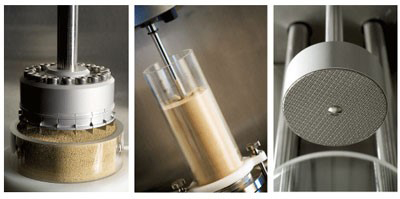
The newest addition to the ceramic technology and process control department at Multotec Wear Linings is the Freeman FT4 powder rheometer, a bladed mixer-like powder flow tester. The FT4 was designed with one purpose in mind - to characterise the rheology of powders, or powder flow properties while this remains a primary function, the instrument, accessories and methodologies have been developed to the point where the FT4 is now considered a universal powder flow tester. It is used to characterise powder flow properties by measuring the resistance (force and torque) encountered by the rotating blade when penetrating the powder bed.
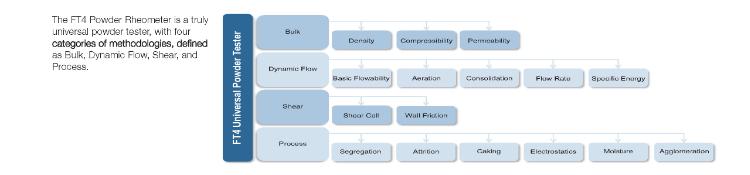
The FT4 is a truly universal powder flow tester, with four categories of methodologies, defined as bulk, dynamic flow, shear and process. It differs from other powder testers in many ways but when assessing its industrial value, three features are critical:
■ The ability to simulate powder processing conditions, by testing samples in consolidated, moderately stressed, aerated, or fluidised state.
■ The application of multi-faceted powder characterisation to assess dynamic powder flow, bulk, and shear properties, to construct the most comprehensive understanding of how a powder behaves.
■ Unparalleled sensitivity, enabling the differentiation of powders that other testers classify as identical.
With the acquisition of this instrument, we aim to gain the capability to predict in-process performance of granulates, understand batch differences and to ensure the quality of the granulate after spray drying. Dry powder pressing techniques are the most cost-effective and flexible choice for the manufacture of a wide range of ceramic components.
A first step toward the successful manufacture of a ceramic component using a powder pressing technique is to develop an appropriate feed material. As ceramic powders are often supplied as submicron or nano-sized particles, it is usual practice to include an initial granulation step. The ideal outcome from granulating a well-specified mix of ceramic powder, binders, lubricants, and dispersants to a suitable endpoint, will be a feed of consistent composition that delivers high levels of productivity and meets product quality targets. Material must flow easily from a hopper, fill a die adequately and compress to form a stable green body that can be successfully ejected from the mould before sintering and sometimes final machining.
Granulates with properties that are suitable for dry pressing requires careful manipulation of a variety of parameters, including particle size and distribution, degree of agglomeration, composition (e.g., binder content) and particle shape and texture.
One of the major challenges in this process is how to characterise granulates in ways that relate to in-process performance and finished product quality. Without appropriate measurement tools, the performance of a potential feed material can be assessed only through plant trials on either a lab- or pilot-scale, which is a costly and time-consuming option. Characterising powder properties effectively can both accelerate and optimise the process to deliver high quality ceramic product. Although manufacturers have had a wide selection of powder characterisation techniques from which to choose, the applications within the industry exert some quite specific (though not unique) demands. Quantifying flowability is essential because the material needs to flow freely, in a controlled way, out of a hopper into the feed shoe and from there to the die. Understanding the response of the powder to air is critical.
Air exerts a major influence on powder flow properties and is especially important in die filling via gravity. Here, the air content of the powder in the feed shoe, while often uncontrolled, affects flowability during discharge. Powder entrains air as it leaves the shoe, which lubricates the filling process and simultaneously reduces bulk density. If this air is not easily released as the powder settles in the die, then bulk density remains low, compromising fill weight. De-aeration behaviour is therefore also highly pertinent. Sensitive differentiation in all these areas is a vital attribute of a truly useful characterisation tool.
Many conventional powder measurement methods are limited by their lack of reproducibility and questionable relevance to the manufacturing process. Many techniques record just a single parameter for a given powder, failing to capture the behavioural complexity that ceramic processes need to assess. Powder characterisation technology has, developed significantly over the past decade. The maturation of dynamic measurement techniques and the emergence of universal powder testers that offer multi-faceted characterisation are both worthy of note.
This universal powder tester combines conventional shear and bulk testing with more modern dynamic methodologies. Dynamic measurements of the powder in motion not only quantify flowability in an intuitively relevant way, but also permit investigation of the impact of air. Samples can be measured in a compacted, conditioned, aerated or even fluidised state. Closely defined test protocols and sample conditioning give this instrument the excellent reproducibility that makes it highly differentiating.
Optimal die -filling performance requires a powder that is free flowing with relatively high permeability. An ideal powder aerates enough to flow easily, yet de-aerates sufficiently quickly to ensure complete die-filling. Quantifying these characteristics provides a specification for feed materials that will perform well. 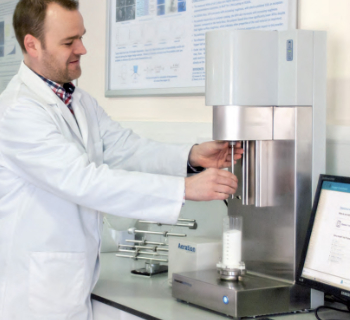
Measuring and understanding the flow properties of powders with the FT4 Powder Rheometer
Powder characterisation that is both reliable and relevant to the process makes it easier to predict die-filling performance. A good match between the feed and the rest of the plant will result in a robust and stable process that maximises throughput and quality. The Freeman FT4 Rheometer will sensitively and precisely determine these essential characteristics of powder behaviour, supporting and accelerating the 4IR requirements on powder processing.