

- Home
- Articles & News
- Select screen media to optimise processes
Select screen media to optimise processes
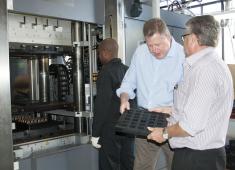
Rhodes Nelson, managing director of Multotec Manufacturing and Roy Roche, vice president screen media at Multotec inspecting a newly designed screen panel.
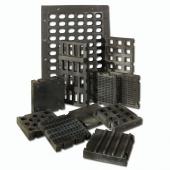
Multotec produces a comprehensive range of rubber screen panels
Asset optimisation is the primary objective across all mining houses, however the translation of what this means is different depending on the commodity, the mining process and the level at which decisions are made.
Collectively the minerals processing plant is part of the overall asset base and optimisation of these will vary from commodity to commodity and from mine resource to resource.
Rhodes Nelson, managing director of Multotec Manufacturing, tells Modern Mining that some iron ore mines are focussing on increasing the throughput volume because their business model is based on the cent per ton calculation. Other mines are using the differences in their geological resource characteristics and therefore have to look at optimising the product quality to create differentiation.
“The same is true in the diamond sector where mines producing gem quality stones are increasing throughputs to increase yields while those producing industrial type application diamonds are trying to reduce the cent per ton model,” Nelson says.
He says there has also been a major increase in waste dumps being recycled across a range of commodities. “This,” he explains, “is another opportunity to squeeze volume out without having to deal with the mining constraints and allows miners to meet long term contractual requirements.”
Although greenfield capital project plants have largely dried up, there remain brownfields opportunities within existing operations and together with recycling dumps presents the need to optimise plants to adapt to the changing throughput and grades required by their customers.
Market conditions coupled with the ongoing drive to optimise minerals process plants have led to a situation where the control of the changes in the ore body is heightened more so than in more economically relaxed times.
“This has made the selection of screen media more important than ever to make sure that it will fit into the sweet spot for the plant because of this variability. Add to this, the sweet spot is a constantly moving target and, where in previous years, a screen media solution supplied would have stayed in place for extended periods, today this is no longer the case,” Roy Roche, vice president screen media at Multotec, says.
He cautions, however, that changing the throughput on a screen is not the simple exercise that many mines believe it is. “It requires the input of skilled process engineers who can recognise that there are a number of factors that need to be considered.
In previous years, there would probably have been just one type of screen media on the screen. This has changed dramatically in the drive to optimise screening operations and has led to increased innovation and out-of-the-box thinking in terms of applying fit-for-purpose solutions to screens. Roche says that in some applications today, there are up to nine types of panels on a screen deck.
“Another example would be where a combination of compression moulded and injection moulded rubber panels are used along with diverters to ensure optimum throughput with well over 95% screening efficiency,” he says.
An example would be where specially engineered screen panels which combine Hardox® embedded in rubber have been installed on the feed sections of screens in an iron ore application. These panels are capable of handling the impact of the 600 mm top size. On the same screen bed, high impact slotted skid bar panels, known as Multotec Ratel panels, are used to reduce channelling and ensure accurate cut size while providing maximum screen panel life. In this self-same screening application, deck combinations of Multotec O-Slot panels are used to ensure overall cut size efficiency and again maximise life.
“It is the combination of the Ratel and O-Slot panels that ensures material throughput and screening efficiency, and importantly, it is through the clever design of these screen panels that the aperture cut size is maintained for a longer period,” Roche says. “This translates into improved screen efficiency allowing the sweet spot to be maintained for longer, with the added advantage of greatly reduced maintenance.”
Multotec is well positioned in this market space in that the company is able to offer customers optimum flexibility in design as well as access to its world-class production capability. Nelson explains that this value proposition is underpinned by the company’s strong base of internal research and development.
“Being able to effectively engineer and produce the wide range of screen panels required to meet this changed environment in screening, and at a lower volume per panel type, necessitates absolute agility and flexibility in the back end of the production facility,” Nelson says.
At Multotec this is possible because of the company’s extensive design capability. Significantly the company has integrated its technical and design capability into its process knowledge and it is the leveraging of this together with its skilled human capital that allows the agility that has differentiated it in the market.
Nelson says technical designers are able to react to the customer-specific requirement and provide an optimum solution where screen panels are appropriately positioned on the screen deck.
Commenting on the speed of responsiveness and capability for which the company is known, Nelson cites an apt example that demonstrates this. “Our team was able to design and manufacture six completely different moulds and four completely separate sets of inserts in two weeks for eleven different panel designs for a trommel in an iron ore application.”
He explains that typically a trommel screen would have one or two types of panels at the most.
“Significantly, this is one of the major advantages of dealing with Multotec as we do not subscribe to the philosophy that a standard screen panel must be made to fit a screen. We maintain close working relationships with customers and have numerous references where custom-designed panels have been supplied as fit-for-purpose solutions,” he says.
“Being proactive has always been one of the major differentiators that Multotec brings to the market and this has not changed. We are focused on the vertical integration of technology in our organisation with the sole objective of being able to identify trends and align ourselves proactively with customer requirements,” Nelsons says.
This requires a close collaboration with its customer base and the ability to deliver on the requisite solutions. Nelsons says that the company has reconfigured its facilities including the tool room capacity and the rubber injection moulding capacity to ensure its agility can be easily maintained.
“The success is in the DNA of how Multotec works. People can buy the same equipment and companies can copy our products but it is not that simple to reproduce the DNA that has made Multotec a force to be reckoned with when it comes to screen media,” Nelson says.
“This is what makes Multotec special and the level of repeat business being received underpins this statement. Our people eat, breathe and live screen panels. This level of focus will ensure our sustainability going forward and our collaborative approach will allow customers to ensure their screening plants operate at optimum efficiency and that the lowest overall cost per ton is achieved, Nelson concludes.
Furthermore, Multotec, as part of its commitment to furthering the skills base in screening knowledge in South Africa, has invested in the setting up of research and development projects at local universities. Nelsons says there remains the need to ensure that not only does knowledge get transferred but that fresh ideas and innovation are consistently encouraged in the field of screening and screen media through fundamental research as well as the investment in test facilities.
Published by Modern Mining