- Home
- Articles & News
- Triumph in Mozambique: Celebrating our commissioning success
Triumph in Mozambique: Celebrating our commissioning success
At Multotec, innovation and success drives us forward, and servicing our clients is our business.
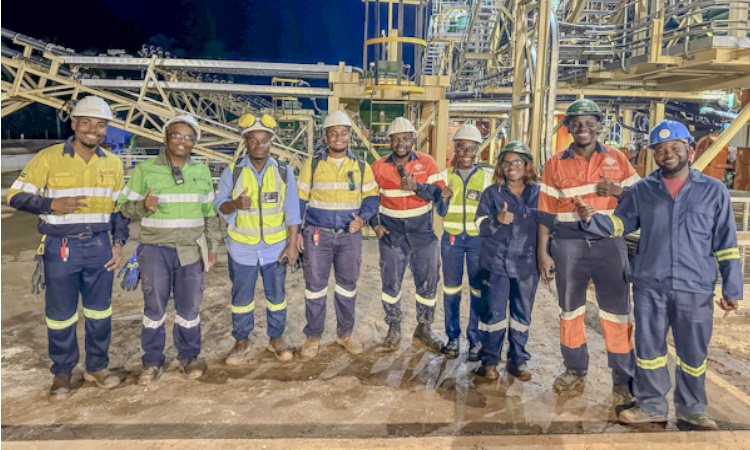
I recently went to Mozambique with Hamilton Shwebede and Kgabo Mashita for the commissioning of three 40 tph heavy mineral pilot plants for a global mining company through one of our design house clients.
Each of the plants consists of three stages of spiral separation, pumps, and cyclones. Let me share with you the journey we took in commissioning the plants, highlighting the challenges we faced and the lessons we learned along the way.
Multotec’s commitment to staying at the forefront of technological advancements and looking for innovative ways to solve client’s problems necessitated the creation of our pilot plants.
Pilot plants are an ideal solution for small miners who do not have big budgets to design a full-scale plant with the help of design houses or clients who just want the flexibility to move their equipment between different locations.
Although this project is for a big mining giant, they wanted to test the feasibility of the project by installing a pilot plant first, with plans to eventually expand the plant to a 1000 tph capacity.
Our pilot plants were the perfect solution.
A lot of planning went into our commissioning journey, to complete the C3 and C4 stages of commissioning. Commissioning took three weeks to complete, and ultimately, we managed to run at full 120 tph capacity. This was also a chance for us to showcase the recently developed 117HM spiral, and as expected, it delivered. Overall, the commissioning was a success, resulting in a well-functioning plant ready for full-scale production.
The client is happy with the spiral performance, and the next commissioning stage (C5) is planned for the fourth quarter of this year when more optimisation tests will be performed on the spirals.
Commissioning the pilot plants was a complex but rewarding experience for me personally, especially since the site was in a very rural area where there were very few women on site.
The workplace culture in the mine is not always welcoming, and women are often subjected to inappropriate comments, putting up with guys' talk, and struggling with physically challenging activities.
Plant commissioning requires long hours, which can be challenging for a woman balancing work with family responsibilities. I was very fortunate to have Kgabo and Hamilton there with me. The team demonstrated excellent coordination and professionalism.
At the end of the day, the experience and exposure were priceless, and I would not trade them for anything. The journey provided invaluable insights, hands-on learning, and the opportunity to work closely with a dedicated team.
The whole experience was truly unforgettable.
The mining and engineering sectors have long been perceived as male-dominated fields, but this narrative is rapidly changing. Women all over the world are making significant strides and breaking barriers.
Through initiatives such as mentorship programmes and career workshops, more women and young girls in schools can be encouraged to pursue careers in these fields. This will help create an inclusive and diverse workforce, which is essential for driving innovation and growth.
This Women’s Day, let us take the time to acknowledge all the women who are in male-dominated workplaces, but also let this be an encouragement to young women to say we are also capable and competent.
Even though certain aspects of the job are physically challenging for us, we can make an impact where we are, and we can make a difference.