


- Home
- Articles & News
- Water and Sanitation Africa’s Panel Discussion
Water and Sanitation Africa’s Panel Discussion
Questions
- The Multotec Group offers a wide range of products and services for mine water treatment. What are some of your solutions and what types of process water are they geared to treat?
Multotec’s new technology for process water treatment, Continuous Ionic Filtration (CIF®)can be utilised in various different configurations to treat a wide range of process waters. For example, when treating acidic, sulphate dominant mine water a dual stage CIF® system, known as DeSAlx®, is used following conventional precipitation to achieve zero liquid discharge by incorporating a brine recycle stream. This is only possible due to the novel design of the CIF® columns and its ability to handle in-column precipitation. Single stage CIF® can also be used to recover a wide range of target metals from effluent streams and tailings water or to selectively remove contaminants such a nitrates from process water.
- Could you please tell readers more about the Group’s recently released Continuous Ionic Filtration (CIF®) system and its benefits?
Multotec partnered with Australian company Clean TeQ to bring the novel patented CIF® technology to the African market. The CIF® process can be likened to continuous sand filtration; the principal difference being that with CIF® charged resins are used instead of sand and the process continuously removes dissolved salts in addition to suspended solids. The continuous movement of the resin is performed counter-currently to the movement of solution, which creates a concentration gradient that naturally drives the ion exchange reaction, thereby reducing reagent consumption and brine production. The high solids handling capability of CIF®, due to the continuous movement and external washing of the resin, also means that CIF® can handle in-column precipitation and therefore has the ability to regenerate using low cost chemicals such as lime and sulphuric acid. CIF® can operate under highly fouling and scaling conditions without the requirement for extensive pre-treatment. Ultimately the CIF® process allows treatment at high water recoveries with comparatively lower operating and capital costs.
- How does this technology compliment the rest of your market offering?
Multotec promotes sustainability in all industries in which it operates and this product provides an environmentally friendly solution for its customers. This technology is also a natural progression of Multotec’s current line of solid-liquid separation equipment. Multotec currently provides filter presses, screw presses and centrifuges to the water and wastewater treatment industry. These technologies are complementary, especially when incorporating CIF® into a zero liquid discharge solution where sludge handling and dewatering is critical.
- What features of your solutions reduce downtime as well as operation and maintenance costs?
As mentioned, the counter-current movement of resins reduces the reagent consumption required for regeneration. Additionally, CIF® has very low power consumption in comparison with some other water treatment technologies such as reverse osmosis (RO). Downtime is limited, due to the fact that CIF® can operate under highly fouling and scaling conditions and does not require regular cleaning, as is the case with RO. The system is also fully automated and remote monitoring can be incorporated, reducing the need for operator intervention.
- Could you provide more detail about your water treatment offerings – in terms of treatment capacity, standards and durability?
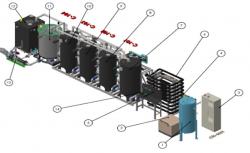
The CIF® technology can be built in either both modular and mobile configurations. A single stage CIF® unit can be containerised in modules of 0.5 to 1 ML/d. These containerised units can be modularised up to 5 ML/d, after which we recommend the construction of a free standing plant. The containerised units are fully automated and typically consist of one container for the CIF® columns and a separate container for the process tanks. The units are piped, wired and ready to operate and require 1 to 2 days to facilitate site connections before being fully operational.
- What type of value-added services do you offer clients to ensure total risk management and environmental performance peace of mind?
Multotec works with project partners to be able to provide customers with a total water treatment solution. With these partners, Multotec could consider providing customers with risk management options such as build-own-operate or lease agreements on plants.
- What is the process of commissioning a plant and what requirements need to be met first?
Representatives from Clean TeQ and Multotec take a facilitative role during cold commissioning and hot commissioning. Training is provided to site personnel at this time, and Clean TeQ and Multotec work directly with operators to ensure complete understanding of the process, operation and maintenance. Dependent on the size of the plant, a representative from Clean TeQ or Multotec will remain on site throughout a 30 day performance period. Multotec will continue to work closely with site operators until they have built up sufficient knowledge to confidently operate the plant on their own.
- How does Multotec’s new technology incorporate into current water treatment processes and conventional technologies?
The CIF® technology is highly complementary to conventional water treatment technologies such as reverse osmosis (RO). The technology is complementary to RO in that it combines softening and dealkalisation to remove scaling ions and filtration to remove suspended solids, in one unit process. This pre-treatment contributes to an increase in overall water recovery and significantly decreased power consumption on the water treatment plant.
- Extra question: How does Multotec technology handle the changing feed conditions frequently experienced in mining and industrial applications?
The CIF® technology is very flexible and it can be adjusted according to changing feed conditions simply by adjusting the rate of resin transfer, thereby increasing/decreasing the loading time accordingly. This can be incorporated into the automation system which means that the process will automatically adjust the resin transfer rate and thereby maintain the desired product water quality.
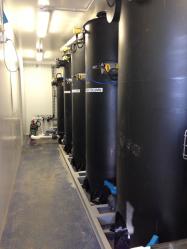
Containerised CIF
CIF Container